Hawarden Airfield, Broughton
Disgrifiadau
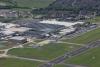
The development of the airfield at Hawarden/Broughton is closely linked to the establishment of the factory, covering some 141,000,000 sq ft, for the production of the Vickers Wellington bomber. The airfield was developed on land which had been used by RAF Sealand as a relief landing ground. A short concrete runway was built for testing the Wellingtons, followed by two more runways in the spring of 1941. Several different types of hangars were constructed which remain extant and in use.
Event and Historical Information: Hawarden developed as a result of a government funded programme of shadow factories which could begin to produce the aircraft that might be needed in event of war. Work started on the factory in November 1937 with the adjoining land being requisitioned as s flying filed. The first contract was placed in May 1939 for 750 Wellingtons assembled in a Bellman hangar. Wellington assembly continued until October 1945, with 5,540 being completed. 48 Maintenance Unit (MU) was formed at Harwarden on 6 March 1940 to prepare Vickers Wellingtons, Westland Lysanders, Handley page/Hampden Herefords and Blackburn Bothas for operational use. Other users of Hawarden were the Air Transport Auxiliary, which eventually came under RAF command and operated as No 3 Ferry Pilots Pool (FPP) until disbanded in November 1945. There was also a succession of Operational Training Units (OTU) for fighter and fighter-reconnaissance flights. The first was 7 OTU on 15 June 1940 with Supermarine Spitfires, Hawker Hurricanes and Miles Masters. The unit was re-number to 57 OTU on 28 December 1940. New runways were built over the winter of 1940-1 by Gerrard of Manchester and in June 1942, the OTU achieved the all-time highest monthly airtime record of 5282 hours. However overcrowding on the flying circuit became a particular problem for Vickers who were wanting to air-test Wellingtons. Some units were reassigned to other airfields, and satellite airfields further developed such as Poulton, Aberfraw and Tatton Park. At the end of the war between June-September 1945, more than 1000 aircraft were brought to Hawarden to be broken up by the Maintenance Unit. Vickers, who had switched to building Lancasters in June 1944, ceased production in September 1945. Aircraft construction returned in 1948 when de Havilland took over the factory and under re-organisation of the British aircraft industry become part of Hawker-Siddeley and then British Aerospace as it continues today. The RAF station closed on 31 March 1959. Sources include: Defence of Britain Project Phillips, Alan, 2006, Military Airfields Wales, pg 96-107 Smith, David J, 1982, Action Stations 3: Military Airfields of Wales and the North West, pg 85-90
More items with these tags
Mae'r eitem hon hefyd yn ymddangos yn

Cysylltwch â Ni
I wneud cais i dynnu i lawr neu riportio cynnwys hiliol, sarhaus neu niweidiol mewn unrhyw ffordd arall.
You must be logged in to leave a comment