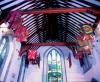
Baneri catrodol Cyffinwyr De Cymru yng Nghadeirlan Aberhonddu
Baneri catrodol Cyffinwyr De Cymru yng Nghadeirlan Aberhonddu
Disgrifiadau
Sefydlodd Catrawd Rhif 24, Cyffinwyr De Cymru, eu pencadlys catrodol yn Aberhonddu ym 1873 a chysegrwyd Capel Havard yng Nghadeirlan Aberhonddu fel y Capel Catrodol ym 1922. Ym 1934, cyflwynwyd y Baneri enwog a gariwyd gan y Gatrawd yn ystod Rhyfel Zwlw 1879 i'r Capel. Achubwyd Baner y Frenhines Rhif 1/24 gan yr Is-gapteiniaid Melvill a Coghill wedi'r trychineb yn Isandhlwana. Anrhydeddwyd y ddau, a laddwyd gan y Zwlŵaid, gyda'r Groes Victoria wedi'u marwolaethau. Rhoddwyd y baneri arbennig hyn mewn casys yn 2002, oherwydd eu pwysigrwydd ac er mwyn eu gwarchod rhag dirywio ymhellach.

More items with these tags


Cysylltwch â Ni
I wneud cais i dynnu i lawr neu riportio cynnwys hiliol, sarhaus neu niweidiol mewn unrhyw ffordd arall.
Sylwadau (1)
Submitted by Casglu'r Tlysau on Llun, 07/11/2011 - 10:45
Response from South Wales Borderers Museum: The user is of course correct in what he/she has said - to an extent. There are clearly many errors in the film "Zulu", for example, where the Regiment is identified as the SWB. It would have been nice if they had gotten all the facts right in the film. However, the film was not produced as a documentary. And of course, the Regiment and Museum had no say in its content.
In 1881 the 2nd Warwickshire Regiment (24th Regt of Foot) changed its name to the South Wales Borderers to reflect the position of its Regimental Depot in Brecon (where it had been based since 1872/3), but still remained the 24th Regiment of Foot . So, same Regiment - different name ! Many other Regiments also changed their names at this time based on their geographical locations.
How many Welshmen were there in the Regiment at this time ? It's impossible to say, the data is quite inconclusive. You initially need to define the term "Welshmen". Is it someone who was born in Wales; or lives in Wales, or speaks Welsh, or who has a Welsh father: etc, etc . All we can say with certainty is that the 24th (and 23rd and 41st) Regiments, being based in Wales, all contained a higher proportion of Welshmen than the other regiments. The 25th Brigade based in Brecon (which included the 24th Regiment) recruited (in theory) from four local counties.The regiment was relocated to Brecon in 1872/3 to take advantage of the recruiting possibilities offered by ther highly industrialised area along the heads of the South Wales valleys. Most recruits at this time were unskilled industrial labourers (as opposed to the previous century when unskilled agricultural labourers provided the bulk of recruits). In simple mathematical terms, if the battalion of 850 men was composed of 12 year men, then it would need (on average) to find 70 recruits per year, multiply this by 6 (the number of years at Brecon) and by 2 (the number of battalions) you get something likethe number who OUGHT to have been Welsh (some 50%). If the battalions were composed wholly of 6 year men, then the percentage OUGHT to have been 100%. However, a person's name, where he was from, and where he enlisted give no real sound indication of a nationality. You can not assume that the name Williams, Evans or Jones equated to being Welsh, or the fact that he was from Merthyr Tydfil. There were also a lot of Irishmen who were working in the coalfields, and in the iron and steel works in this area!! There is therefore no way that anyone can say conclusively that of the defenders at Rorkes Drift "only 14 were Welsh". We will never know for certain the exact number.
Within the Anglo-Zulu War room in our Museum we do not state that the Regiment was either Welsh or English ! There were strictly NO Welsh regiments or English regiments - the regiments were of course regiments of the British army. And of course an Act of Union had previously UNITED Wales and England !
Interestingly, we have been looking at the Welsh language press in Wales at this period - there were well over 200 newspapers printed in Welsh. Many of these do describe the 24th as "our Regiment" so there was clearly, even at this stage, a growing sense of identity with Wales. This has obviously continued to develop and strengthen over the years, through the various titles of the Regiment - The South Wales Borderers, the Royal Regiment of Wales and currently The Royal Welsh.
You must be logged in to leave a comment