The Trimsaran Mining Disaster of 1923
Disgrifiadau
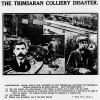
The Trimsaran Colliery Disaster of 26 April 1923: A Tragedy That Shook the Gwendraeth Valley
Although this story is not solely about Kidwelly, the communities of the Gwendraeth Valley have long been bound together through generations of farming, industry, family ties, chapel life, and sporting rivalries. When disaster struck at Trimsaran Colliery on 26 April 1923, the shockwaves were felt far beyond the village itself. From Trimsaran and Carway to Kidwelly, Ferryside, Pontyates, Ponthenri, Pontyberem, Tumble, Burry Port and Llanelli, the entire valley was drawn together in grief and solidarity.
The events that unfolded at the Caeduan Slant that Thursday afternoon remain among the darkest chapters in the industrial history of the Gwendraeth Valley. For those who witnessed the aftermath—the rescuers who descended into the workings, the doctors who rushed to the scene, and the families who waited anxiously at the pithead—the memories would endure for the rest of their lives.
A Prosperous Colliery at the Heart of the Valley
By 1923, Trimsaran Colliery was one of the principal employers in the district, providing work for approximately 560 men. The mine had become a central part of community life, supporting countless families throughout the valley.
The colliery had been acquired seven years earlier by Evan Jones, who purchased the Trimsaran Estate and invested heavily in the operation. Under the management of Evan Davies, who had been in charge since 1916, the mine had developed into a major industrial concern.
Yet mining remained inherently dangerous. The Gwendraeth Valley had already witnessed several serious accidents, including disasters at the same colliery in 1907, when six men lost their lives, and another fatal incident approximately fourteen years before the 1923 catastrophe.
The Disaster at the Caeduan Slant
On the afternoon of Thursday, 26 April 1923, approximately ninety-five miners who had completed the morning shift boarded a rake of eleven carriages to be hauled from the workings via the Caeduan Slant, a steep underground incline stretching roughly a mile in length.
The journey had reportedly travelled only around four hundred yards when disaster struck.
At one of the steepest sections of the incline, the shackle connecting the leading carriages failed. In an instant, the remaining loaded carriages broke free and hurtled uncontrollably backwards down the gradient.
Men were thrown into a desperate struggle for survival. Some managed to leap clear and scramble to safety alongside the track. Others were dragged along the incline or hurled violently from the carriages as the runaway rake gathered speed.
After racing more than three hundred yards downhill, the carriages left the rails. A tool tram was forced into a support pillar and the entire journey telescoped into a mangled mass of wreckage at the bottom of the drift.
Remarkably, many of the men in the final carriage escaped serious injury, but for those in the middle sections of the train the consequences were devastating.
Chaos Underground
The afternoon shift had gathered at the surface awaiting their descent when news of the catastrophe reached the pithead. Without hesitation, miners organised themselves into rescue parties and entered the workings to aid their trapped comrades.
The scene they encountered was horrifying.
Coal dust hung thickly in the air. Groans and cries for help echoed through the darkness. Splintered timbers, twisted ironwork and shattered carriages lay strewn across the drift. Many men were trapped beneath the wreckage, some suffering dreadful injuries.
Rescuers later recalled being met by injured miners making their way painfully up the slant. Despite their own wounds, many urged the rescuers to hurry to the aid of comrades still trapped below. Such acts reflected the deep sense of solidarity that characterised mining communities throughout South Wales.
One particularly difficult rescue involved a miner, Henry Evans, who had become trapped between two crushed carriages. The wreckage had to be cut apart before he could be freed. During the operation a fall of debris occurred, sending several trams’ worth of rubbish crashing down the incline, though fortunately no further casualties resulted.
A Village in Mourning
As word spread across the valley, Trimsaran was transformed from a quiet mining village into the centre of a major rescue operation.
Motor ambulances arrived from surrounding towns and villages. Doctors rushed to the scene in motor cars. Volunteers assembled from every direction.
At the mouth of the slant, a heartbreaking spectacle unfolded as the dead and injured were brought to the surface in trams.
Doctors worked tirelessly, often in shirt sleeves, treating wounds and organising the transfer of the most seriously injured to hospital. Others were transported home to their families.
Along the banks above the drift stood anxious wives, mothers, fathers, children and relatives waiting for news. As names began to emerge, scenes of overwhelming grief unfolded.
Among the most poignant sights witnessed that day was that of a young girl running along the roadway towards the pit, weeping uncontrollably as rumours of the disaster spread through the village.
The Women of Trimsaran
The heroism displayed during the rescue effort extended far beyond the miners themselves.
Women throughout the village immediately mobilised to assist. Blankets were gathered from homes and delivered to the pithead. Tea and refreshments were prepared for injured men emerging from the mine. Comfort and practical support were provided wherever needed.
Contemporary reports paid particular tribute to the women of Trimsaran, whose efforts helped alleviate suffering during the long and difficult hours following the disaster.
Working alongside the rescuers was proprietor Evan Jones, who personally supervised operations. His daughter, Miss Marjory Jones, remained at his side throughout the emergency, assisting wherever possible.
Among those present were representatives from neighbouring communities, including John Thomas of Velindre, Kidwelly, and officials from the nearby Ponthenri Colliery, illustrating the collective response from across the Gwendraeth Valley.
Medical Response
The medical response was swift and courageous.
Particular praise was directed towards Dr. Ligertwood, who descended into the drift to treat injured men underground. He was accompanied by Dr. Samuel Williams.
Other doctors who worked continuously throughout the crisis included Dr. E. Evans, Dr. Dick, Dr. James, Dr. Sidney Williams, Dr. D. R. Davies and Dr. Robertson of Kidwelly.
Police officers were dispatched from Llanelli under the command of Superintendent J. E. Jones and Inspector Morgan to assist with crowd control and emergency arrangements.
The Men Who Lost Their Lives
Ten men ultimately died as a result of the disaster:
* William Jenkins, aged 42, under-manager, husband and father of four children.
* Thomas Williams, aged 48, husband and father of a large family.
* Sidney Williams, aged 25, husband and father of one child.
* Thomas John, aged about 68, husband and father.
* Harold Probert, aged 16.
* Harold Parry, aged 15.
* William John Rees, aged 24.
* Arthur John Davies, aged 22.
* Morgan Davies, who later succumbed to his injuries in hospital.
* Thomas Rogers who also succumbed to his injuries in hospital.
Each death represented not merely a statistic but a devastating loss to families and communities throughout the valley.
Particularly poignant was the death of young Harold Probert, who had been employed at the colliery for only a few days. Equally tragic was the death of Thomas John, a veteran miner who was only weeks away from becoming eligible for his old-age pension after a lifetime spent underground.
The Tragedy of Morgan Davies
Among the saddest stories was that of Morgan Davies of Ffoslas.
He died later in hospital, leaving behind a young widow in fragile health and four young children, together with an infant only fifteen months old.
The family’s circumstances were described as extremely poor, with little prospect of financial security beyond compensation payments and charitable assistance. Their plight became emblematic of the wider social consequences of industrial disasters, where the death of a breadwinner could plunge an entire family into hardship.
The Injured
More than thirty men suffered injuries ranging from minor wounds to severe trauma. They came from communities across the valley, including Trimsaran, Kidwelly, Ferryside, Pinged, Carway and Burry Port.
The casualty list reflected the broad reach of the colliery’s workforce and demonstrated how deeply interconnected the communities of the Gwendraeth Valley had become through the coal industry.
Eyewitness Accounts
Among the survivors was nineteen-year-old W. J. Rumbelow.
He recalled hearing a sharp snap while travelling on one of the forward carriages. Almost immediately, the entire rake began accelerating backwards.
Attempting to escape, he found himself unable to free his legs. Moments later the carriages left the rails and he was thrown clear, losing consciousness.
He survived with cuts, bruises and injuries that were considered remarkably light given the scale of the accident.
Like many survivors, he was unable to provide a complete account of events. The speed and violence of the catastrophe meant that most men could remember only fragments of what occurred.
The Investigation and Questions of Responsibility
In the days that followed, attention naturally turned to the cause of the accident.
Evan Jones firmly rejected suggestions of negligence. He maintained that the failure was the result of an unforeseeable defect in the shackle. According to his account, the component had recently been annealed and regularly inspected. The strain placed upon it at the time of failure was significantly below its certified safety limits.
He suggested that an undetected flaw in the weld may have caused the catastrophic break.
Jones also pledged support for the families of the deceased, promising that no dependent would be abandoned. In addition to insurance compensation, he undertook to cover funeral expenses and to investigate each family’s circumstances individually.
A Disaster Remembered
The Trimsaran Colliery Disaster of 1923 ranks among the most serious mining tragedies in the history of the Gwendraeth Valley.
Beyond the ten lives lost and the many injuries sustained, the event revealed the character of the communities that endured it. Miners risked their lives to rescue colleagues. Doctors descended underground to provide treatment. Women organised relief efforts without hesitation. Neighbouring villages rallied to support the bereaved.
For a generation of valley families, the images of that day—the shattered carriages, the dust-filled drift, the anxious crowds at the pithead and the heartbreaking wait for news—would never be forgotten.
More than a century later, the disaster remains a powerful reminder of the dangers faced daily by coal miners and of the extraordinary resilience and solidarity that defined the communities of the Gwendraeth Valley.
(Article created by Mr. Garry Smith from various sources, in the main The Llanelli Star, 28th April 1923,

More items with these tags
Related items


Cysylltwch â Ni
I wneud cais i dynnu i lawr neu riportio cynnwys hiliol, sarhaus neu niweidiol mewn unrhyw ffordd arall.
You must be logged in to leave a comment