Stori Chad
Disgrifiadau
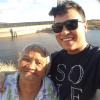
I come from a very matriarchal family, so it makes sense that my story begins with my mum, and with my grandmother, Juliana.
My mum was one of five children, born in Rehoboth, Namibia, to Juliana Kuta and Daniel Jacob Cloete. But in the way families really work, it was Juliana who raised her. My mum was “very much raised alone by my grandmother,” and that same pattern carried forward into my childhood too. I was born in Windhoek, the capital, about an hour away from Rehoboth, and it was also just me and my mum. Women held my world together.
When I was six, we moved to the UK, to Newport of all places, and I’ve been here ever since. I couldn’t speak a lick of English when I arrived. Afrikaans was my language. Namibia was my everything. Now, English is my primary language. I don’t speak Welsh, but my reference points are Welsh and British in the way that happens when a place raises you. I often say I’m Namibian, but a good part of me is Welsh too.
People sometimes want identity to be tidy, like you can only be one thing. But it doesn’t work like that. My father is South African, so I’m half Namibian and half South African, but I feel more Namibian. My earliest years were there, and those years matter. “Zero to six, when you’re really building who you are as a person,” I was Namibian, raised by women only, shaped by family sensibility and community. I was also the first person in my family born outside of apartheid, and I really felt that. Namibia was free, newly free, and that history sat quietly underneath everything.
Our move to Wales wasn’t some grand plan. It was just life turning the way it turns. My mum met someone online, in those early strange days of the internet when everything felt new. The idea was that he would come and live with us, but it didn’t work out. He lived in Newport, so we ended up here, in Cwmbran and Newport for a big part of my childhood. The relationship ended, and it became just me and my mum again. She considered going back to Namibia, but she knew she wouldn’t fit there anymore. She had changed. Wales had shaped her too.
Life in Wales has been very good to me. I’ve had opportunities I wouldn’t have had back home. I was the first person in my family to go to university and complete it. My relationship with my mother is stronger than it would ever have been if we stayed. In Namibia, university might have been free through her work at the time, but the violence is there in a way that sits in the background of daily life. In the UK, university isn’t free, but the violence is less. It’s a kind of trade-off, a duality you live with rather than solve.
And there are other truths. Some are painful to say out loud. My grandmother died and we watched her funeral on Facebook because we couldn’t get there during COVID. That is the kind of grief that doesn’t land properly in your body. It’s real, but it’s distant, like trying to hold water in your hands.
Then there is the fact that I’m gay. In Namibia, that wouldn’t have been okay. For a long time, there were laws that could mean prison. Even now, even with changes happening, it can still feel like acceptance is conditional. Here, I can live openly. I can build a life without having to hide an essential part of myself.
But Wales has not been perfect either. Alongside the good memories, there are moments that stay with you because they are visceral. When I was eight, I was followed home and called the N-word. Things were thrown at my house. The same kids dragged me around the school field and called me the N-word again and again. Then, years later, the day after Brexit, someone looked me in the eye and told me, “We voted for you to go home. Now get lost.” That kind of moment makes you feel the country turn, even if you know logically it isn’t everyone. It makes you feel suddenly visible in the worst way.
I don’t think my experience is unique. Racism isn’t uniquely mine, and neither is homophobia. But the combination, and the way it layers over a life, can feel like it is.
Still, I’ve also seen the best of community here, and I hold onto that too. People in the UK can be very stoic, a bit closed-off at first, but “when it comes to it, they will get together.” I’ve seen it. At the library where I work, we hosted a drag queen story hour. Some people were negative, loudly negative, but the local community came out and stood behind the library and said no, everyone gets access. I’ve seen people stand up to immigration raids too, literally forming blockades around vans. That solidarity is real. Sometimes it just takes longer to appear than it would back home.
In Namibia, community is more immediate. There is an ease to it. You can turn up at someone’s house and borrow flour, or even ask to borrow twenty pounds, and it wouldn’t be strange. There’s a culture of checking on people, of pulling someone into the circle. A braai isn’t just food, it’s hours and hours of being together. Everyone brings something. You sit, you talk, you make bread, you look after each other. It’s not about drinking. It’s about belonging.
I miss the weather too, the heat, the joy of warm days. I love the rare UK heatwaves because they feel like home. In Namibia, you can live in shorts. Even winter mornings can turn into hot afternoons. Here, it rains and people barely react. Summer arrives for a week and disappears again.
But what I miss most is family, not only biological family, but that wider network of neighbours and aunties and people who will notice if you are missing. I remember seeing someone fall down near a train and being the only one who went to help. Everyone else seemed to look away, like, oh no, not my problem. I remember thinking, is this an African thing? Or just a me thing? I think I realised it’s both. I was shaped by that way of living.
My grandmother is part of that story too. Towards the end of her life, she became stubborn in a way that was honestly impressive. She had Alzheimer’s, she was in hospital, and she decided she was done. She just left. She escaped. The hospital called and said, your mother has gone, and my mum wasn’t even shocked because she knew exactly what Juliana was like. Then my auntie called to say our mother had just turned up at her house, even though it wasn’t close. Someone in the community had recognised her, known where her daughter lived, and drove her there. Not because they had to, but because that is what people do. They see you, and they act.
When I think about dreams, I don’t really have the childhood kind anymore. I used to want to win an Oscar. Now I want to be settled and happy. I want to be in a job where I can enjoy every day and come home tired but satisfied. That’s not a small dream to me.
But my bigger dream is for my family, and for Namibia. I want us to be able to help pull ourselves out of the poverty and hardship that still sits there, the long after-effects of apartheid and the struggle of building a young country’s systems and infrastructure. My mum and I always joke about winning the lottery, but we mean it when we say we would set up businesses in Rehoboth and wider Namibia to create jobs and improve lives.
And at the centre of it, always, is Juliana.
My dream is to turn my grandmother’s house into something that lasts. “Juliana’s Sanctuary.” “Juliana’s Garden.” A place that could be a soup kitchen, a recovery centre, a women’s centre, something that gives people safety and dignity. A legacy for the Cloete family, but also for the community that held us.
If I could ask people to understand one thing about my story, it would be this: I am not just one thing. “I contain multitudes.” We all do. We are not just immigrants. Not just people of colour. Not just the surface of what you see in front of you. There is history behind every person, family history, personal history, tiny moments that shape you, losses that change you.
People are not leaving their homes because they want to. They leave because they have to. And even then, leaving is not the whole story. We are always more than that.
I’m proud to be a global citizen. Proud to be “a man of the entire world.” I want other people to feel the joy I feel in that, the joy of being shaped by more than one place, of pulling from different cultures to build a life.
Because in the end, we are all just trying. We are all trying to get through today to get to tomorrow, and one day be the best we can be.

Mae'r eitem hon hefyd yn ymddangos yn

Cysylltwch â Ni
I wneud cais i dynnu i lawr neu riportio cynnwys hiliol, sarhaus neu niweidiol mewn unrhyw ffordd arall.
You must be logged in to leave a comment